We are delighted to share “Nine Bunnies,” a remarkable poem by Stephanie Agosto, written on July 5, 2026, during our Art of Writing experience at the Museum of Art–DeLand.
One of the greatest pleasures of these workshops is watching a work of visual art spark an entirely new creative work, and Stephanie’s poem is a beautiful example of that transformation.
Thoughtful, heartfelt, and quietly powerful, “Nine Bunnies” reflects on patriotism, sacrifice, hope, division, and justice with honesty and grace.
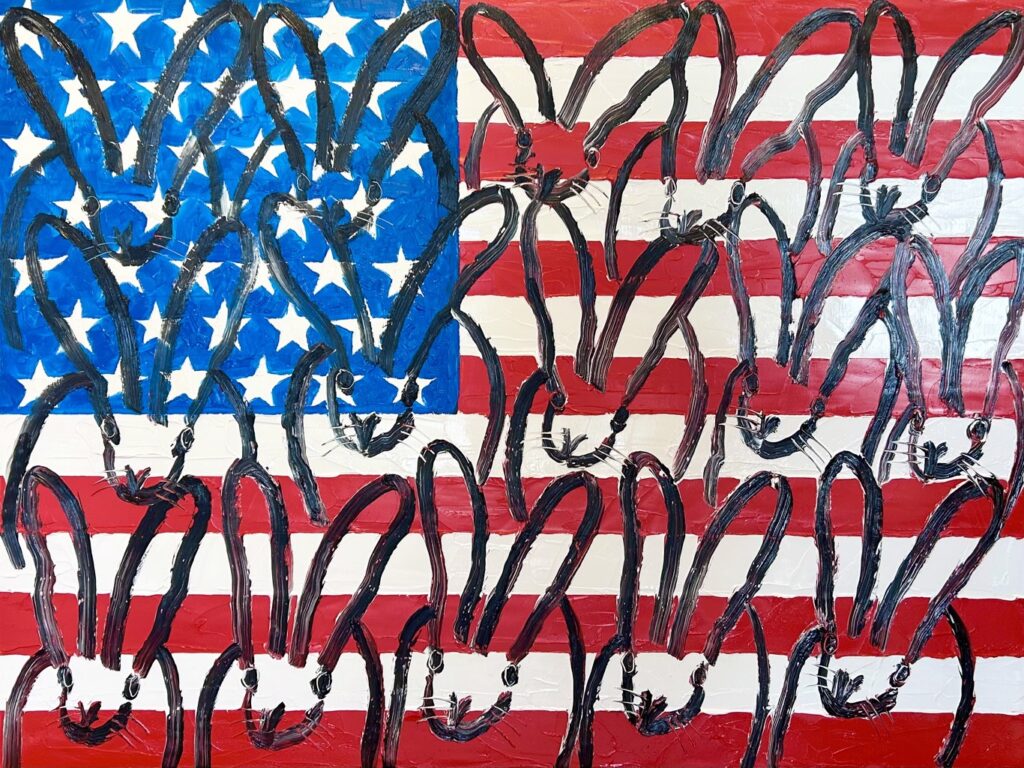
Stephanie found her inspiration in Hunt Slonem’s Flag Day, proving once again that great art has a wonderful way of leading us to great stories—and, sometimes, great poems.
Nine Bunnies
by Stephanie Agosto
Nine bunnies
Nine meanings
Abundance
Adaptability
Curiosity
Good Fortune
Creativity
Fertility
New beginnings
Quick thinking
Wonder
keeps us dreaming
The American Flag
each bunny with eyes of Pride
mixed into the Stars of States
White lines of Hope in between
the fiery red of the blood shed
by soldiers willing to die to keep
a Dream of a Free country
that was never free
Alive
ears capturing truths
not all could hear
or refuse to
The Bad Bunny effect
like the superbowl
causing controversy
Division
Change
Twin realities
Polar opposites
Nine bunnies
Nine meanings
through their Pure Vision
we capture the Blue
with the desire for
Vigilance, Perseverance
and Justice
we want and need
to see
A flag that wants to mean
so much more
than what it means today
It’s an ambitious poem. Stephanie is trying to do something difficult: respond to a painting while also responding to America. That gives the poem weight beyond simple ekphrasis (poetry inspired by visual art). It becomes a meditation on national identity.
She responds to a painting, but she also responds to America. Her poem begins with the rabbits themselves and the meanings we attach to them: abundance, adaptability, curiosity, creativity, good fortune, new beginnings, and wonder. From there, she turns to the American flag and explores the ideals, history, sacrifice, division, and hope carried within that symbol.
The poem’s simple opening—“Nine bunnies / Nine meanings”—gives the piece a strong frame. Its repetition creates a circle, while its short lines and single-word pauses give each idea room to land. Stephanie moves from wonder to bloodshed, from pride to conflict, and from national symbols to personal questions. The shift is bold, and the honesty gives the poem its force.
The closing lines are especially powerful. Rather than offering an easy answer, Stephanie ends with longing: a hope that the flag can mean more than it means today. That choice gives the poem emotional weight and leaves the reader with something to consider.
Inspired by Hunt Slonem’s Flag Day, “Nine Bunnies” does more than describe a work of art. It uses that artwork as a doorway into larger questions about freedom, justice, memory, and belief.
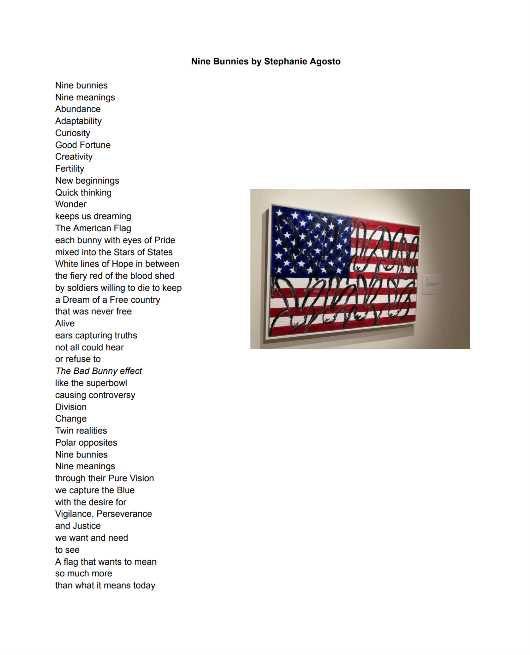
Image: Flag Day by Hunt Slonem. https://www.huntslonem.com
I love this. I really love this eloquently spoken
An inspiring and sad poem, tear jerker because of where we are today. Hope for a better future.
In awe