
A Writer’s Life in Daytona Beach
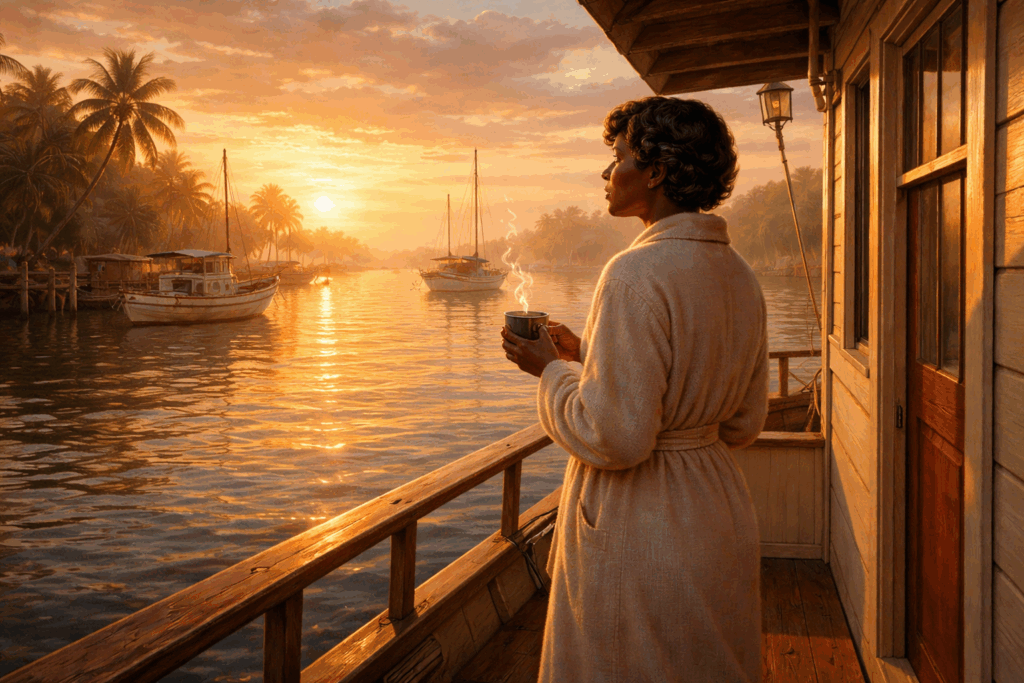
On a typical morning in 1943, Zora Neale Hurston would rise with the sun. She would stretch, shrug into a comfortable robe, and pad barefoot up to the deck of her 32-foot wooden houseboat, the Wanago.
As the water gently rocked the craft, she would watch the Halifax River wake up in layers. Shrimp boats eased out before sunrise. Water slapped wood in a steady rhythm. Voices carried across the docks, unguarded and alive. The river brought heat, rain, work, gossip, jokes, labor, and rest in equal measure. Hurston listened. She always did.
Hurston was part of Daytona Beach’s waterfront community during the 1940s, when she lived at the Howard Boat Works. During those years, she wrote, published, and gathered material that fed both her fiction and her folklore.
Zora Neale Hurston was born in Notasulga, Alabama, in 1891. She was raised, however, in Eatonville, Florida, fifty-five miles southwest of Daytona Beach. Eatonville was one of the first all-Black incorporated towns in the United States.
For decades, Zora Neale Hurston devoted her life to recording the inner life of Black America at a time when few believed it had literary value. She had trained in anthropology at Barnard College under Franz Boas, an unusual path for a Black woman of her era, and she carried that training into every community she entered. Hurston did not collect stories as artifacts. She treated speech, humor, superstition, music, and ritual as living literature, worthy of being recorded without translation or apology.
Hurston’s folklore work was revolutionary because she refused to stand outside the culture she documented. While other collectors filtered Black voices through academic language or moral framing, Hurston recorded stories as they were told. She preserved dialect. She captured humor, exaggeration, cruelty, and joy side by side. Her work insisted that everyday speech carried intellect, history, and art.
Her first connection to Daytona Beach came through Mary McLeod Bethune and Bethune-Cookman College, during the Great Depression. By that time, she was already a force in Harlem literary circles. Bethune invited her with hopes of developing a dramatic arts program rooted in African American expression.
Hurston arrived with ambition and ideas, but she also encountered institutional poverty, limited resources, and constant struggle. Still, she staged From Sun to Sun before a massive audience at the Daytona Beach Auditorium, proving that Black folklore and performance could command public attention even within a segregated Southern city.
Hurston left Daytona in the mid-1930s, frustrated but undeterred, and returned in 1943 with money, recognition, and independence after winning the Anisfield-Wolf Book Award for Dust Tracks on a Road. She used the prize to buy the houseboat. For several years, the river was her address, her refuge, and her writing studio.
Living at Howard Boat Works placed Hurston in daily contact with fishermen, boat owners, dock workers, and river traffic that crossed racial and social lines more fluidly than land ever allowed. She wrote, observed, and collected stories in an environment where people spoke freely and worked hard.
From Daytona Beach, Hurston ranged outward across Volusia County and beyond. She joined shrimp boats through Ponce Inlet to research Seraph on the Suwanee. She traveled inland and along the coast, recording labor, belief, and folklore among both Black and white Floridians. Her work insisted that Southern working lives were complex, dignified, and worthy of serious literature.
Her major folklore collections, including Mules and Men and Tell My Horse, drew directly from fieldwork conducted across Florida and the American South, as well as the Caribbean. In Florida, she returned again and again to labor communities, logging camps, turpentine camps, river towns, and small cities. These were not marginal spaces to Hurston. They were centers of meaning. The stories she gathered there shaped both her nonfiction and her fiction, blurring the line between scholarship and storytelling.
As a novelist, Hurston carried the same principles onto the page. Their Eyes Were Watching God didn’t explain its characters to the reader. It allowed them to speak for themselves. The novel centered a Black woman’s interior life, desire, ambition, and grief without asking permission. That choice, radical in 1937, remains radical now.
Hurston’s later novels, including Moses, Man of the Mountain and Seraph on the Suwanee, pushed against expectations even further. She refused to be confined by racial or political categories, writing stories that explored power, belief, labor, and identity in forms that unsettled critics and allies alike. She valued independence over alignment, a stance that often left her isolated but never silent.
Hurston’s method was revolutionary. At a time when African American folklore was often filtered through academic distance or framed as sociological evidence, Hurston wrote from inside the culture. She allowed humor, cruelty, tenderness, superstition, and contradiction to coexist. Her anthropological discipline gave her precision, but her novelist’s ear gave her rhythm. The result was work that felt alive rather than preserved.
That approach resonates now as strongly as ever. Hurston offers a storytelling model rooted in respect rather than extraction. She didn’t mine communities for material; she lived among them. In Volusia County, that meant recording a Florida of rivers and labor, heat and rain, isolation and intimacy, long before such lives were considered worthy of literary permanence.
Throughout her life, Hurston returned to the same conviction: that culture lives in people, not institutions. It lives in work songs, gossip, laughter, ritual, and belief. Her task, as she saw it, was to listen closely and record honestly.
Hurston returned to Daytona Beach one final time in 1956 to be honored by Bethune-Cookman College for her contributions to education and human relations. By then, her reputation had dimmed and her books were drifting out of print. Yet her voice endured. The later rediscovery of her work restored her place as one of the most important American writers of the twentieth century.
She died on January 28, 1960, after a debilitating stroke. At the time, she was living in obscurity and poverty. She was buried in an unmarked grave at Garden of Heavenly Rest Cemetery in Fort Pierce, Florida. Her grave remained unmarked until 1973, when author Alice Walker located the burial site and placed a headstone.
Books by Zora Neale Hurston
- Jonah’s Gourd Vine (1934) Hurston’s first novel, loosely based on the life of her parents, explores marriage, ambition, faith, and power within a Southern Black community.
- Mules and Men (1935) A groundbreaking folklore collection drawn from Hurston’s fieldwork in Florida and the South, preserving African American folktales, songs, and hoodoo practices in the voices of the people who told them.
- Their Eyes Were Watching God (1937) Hurston’s most celebrated novel follows Janie Crawford’s journey toward selfhood, love, and voice, centering a Black woman’s interior life with unprecedented depth and authority.
- Tell My Horse (1938) A work of travel writing and anthropology based on Hurston’s research in Haiti and Jamaica, examining politics, religion, folklore, and Vodou through direct observation and narrative immersion.
- Moses, Man of the Mountain (1939) A retelling of the biblical Exodus story that blends folklore, myth, and political allegory, presenting Moses as a folk hero shaped by oral tradition.
- Dust Tracks on a Road (1942) Hurston’s autobiographical work reflects on her life, beliefs, and career, blending memory, philosophy, and cultural commentary, sometimes controversially shaped by editorial pressure.
- Seraph on the Suwanee (1948) Hurston’s final novel focuses on a white Florida woman and explores marriage, labor, class, and personal transformation, drawing in part on Hurston’s research along Florida’s rivers and coast.
Sources
-
Bowden, Denny. “Zora Neale Hurston: An African American Novelist’s Life in Daytona Beach.” Volusia County History Blog. March 24, 2014. https://volusiahistory.wordpress.com/2014/03/24/zora-neale-hurston-an-african-american-novelists-life-in-daytona-beach/.
-
Boyd, Valerie. Wrapped in Rainbows: The Life of Zora Neale Hurston. New York: Scribner, 2003.
-
Flemming, Sheila Y. The Answered Prayer to a Dream: Bethune-Cookman College, 1904–1994. Virginia Beach, VA: Donning Company Publishers, 1995.
-
Hemenway, Robert E. Zora Neale Hurston: A Literary Biography. Urbana: University of Illinois Press, 1980.
-
Hurston, Lucy Anne. Speak, So You Can Speak Again: The Life of Zora Neale Hurston. New York: Doubleday, 2004.
-
Long, Nancy Ann Zrinyi. The Life and Legacy of Mary McLeod Bethune. Boston: Pearson Custom Publishing, 2006.
-
Moylan, Virginia Lynn. Zora Neale Hurston’s Final Decade. Gainesville: University Press of Florida, 2011.