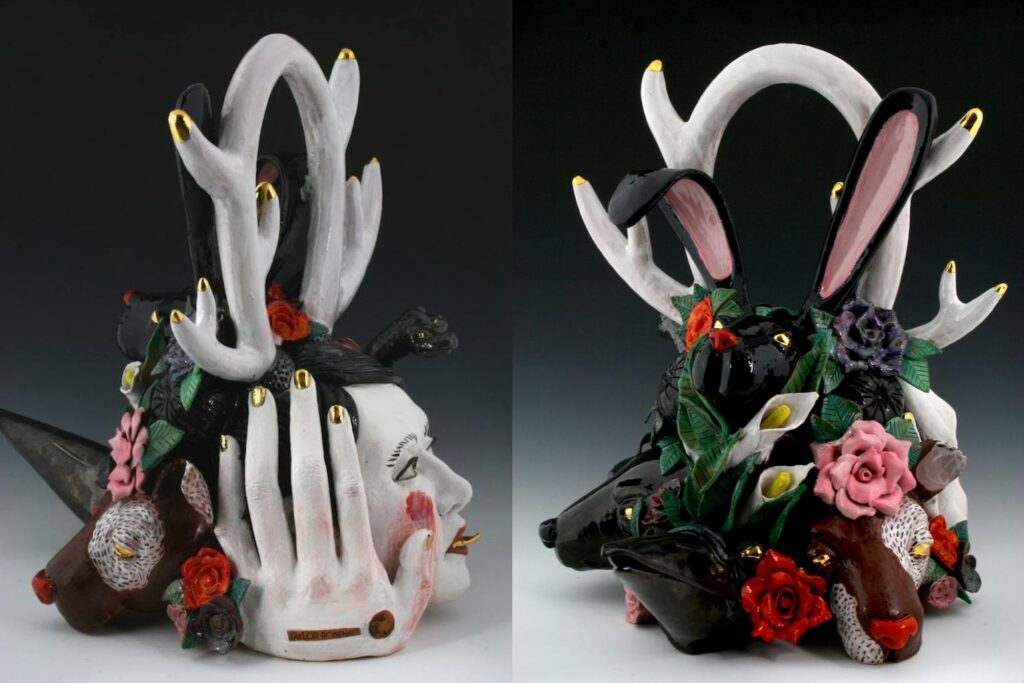
“Connected Antlers,” a ceramic sculpture by artist Taylor Robenalt.
Connected Antlers
A Story Inspired by Taylor Robenalt’s work at the Museum of Art–DeLand
What happens when art stops being something you look at and becomes something that looks back?
Dan Horon drafted this story during our first Art of Writing experience at the Museum of Art-DeLand. It was inspired by Connected Antlers, a remarkable sculpture by artist Taylor Robenalt. The piece blends human and animal forms into a single vision: a woman, a rabbit, woodland creatures, flowers, and hidden details that seem to reveal themselves by emerging from the sculpture one by one.
The result is a tale of hidden connections, living symbols, and the moment when the ordinary world opens just wide enough to reveal something extraordinary waiting beyond it.
Connected Antlers
Chapter One: Breath
By Dan Horon
Maria was beside herself—before she understood that there was more than one of her.
That was the first frightening thought. The second was that the room was too quiet. The third was that, somewhere just outside the reach of her eyes, something was waiting for her to notice it.
She stood in the back gallery of the museum with one hand still resting on the cold brass rail. The building had closed ten minutes earlier. Behind her, the last security gate had settled into its track with a metallic sigh. Ahead of her, on a narrow pedestal beneath a single white lamp, stood the sculpture she had come to see: a woman’s head turned in profile, a horse nosing out from behind it, a forest of white fingers and antlers rising from the crown, every nail tipped in gold.
It should have been ridiculous. It should have been an object that could be named, cataloged, and passed by. Ceramic, paint, glaze, mixed media. Approximate dimensions. Artist unknown to Maria until that morning. Instead it looked like a thought that had learned to become solid. A thought with teeth, hooves, hands, flowers, and horns.
Maria tried to look away, but the faces in the piece kept rearranging themselves in her mind. The woman’s closed eye. The horse’s long dark cheek. The white hands pressed up like a warning or a prayer. The antlers that were not quite antlers, because some of them looked too much like fingers reaching for the ceiling. It was beautiful in the way storms were beautiful when you watched them from a window.
She closed her eyes.
At once the images flooded her. Connections. Creatures. Individual intentions. Purposes. They did not arrive as words exactly, but as pressure, as if invisible threads had been tied from her ribs to everything alive in the room. She felt the dust in the velvet ropes, the sleeping flies in the corners, the dry thirst of the wooden floor. She felt the sculpture most of all, not as clay, but as a crowded house.
Maria opened her eyes too quickly and staggered back.
Then she remembered the advice her iawaska practitioner had given her, the only practical advice that had seemed simple enough to survive panic: Breathe.
The first breath was only a gasp, sharp and embarrassing in the empty gallery. The second reached a little deeper. The third found the place beneath her fear where her body was still willing to help her. She held the rail until her fingertips stopped trembling.
“It’s about time,” said a black rabbit.
Maria didn’t scream. Later, she would think this was the first proof that the evening had changed her. The rabbit sat under the bench opposite the sculpture, its fur blacker than the shadow around it. Its ears were too long, its eyes too bright, and one paw rested on the floor as if it had been waiting with great impatience for a curtain to rise.
“Come on,” the rabbit said. “We have got some exploring to do.”
Maria looked from the rabbit to the sculpture, and back again. “Rabbits don’t talk.”
“Most people don’t listen,” said the rabbit. “The error is usually on your side.”
A sound came from behind the pedestal: a small scrape, a breath, a scale sliding over polished stone. Maria turned and saw another creature unfolding from the dark. It was a snake, or had begun as one, but halfway along its body, another head rose and blinked at her with solemn patience. One head watched Maria. The other watched the rabbit, as if expecting him to take credit for everything.
From the shadow of a nearby display case hopped a bird, all elbows and angles, with feathers that looked borrowed from several other birds. It shook itself, gave a dry little cough, and bowed. More shapes emerged after that—a fox with moth wings folded along its back. A beetle carrying a crown of moss. A small horse no higher than Maria’s knee, its mane braided with red flowers. They approached gently, timidly, as each made her acquaintance.
Maria’s first instinct was to count them. Her second was to identify them. Her third, which was new, was to stop doing both.
They were familiar, but not like friends and not like strangers. More like forgotten instructions. Each one carried a feeling: caution, hunger, mischief, grief, courage, memory. They gathered before her in a half-circle while the rabbit groomed one ear with insulting calm.
“Are you from the sculpture?” Maria asked.
The two-headed snake considered this. One head nodded yes. The other shook its head no.
“That’s not helpful,” Maria said.
“It is accurate,” said the rabbit.
The bird clicked its beak. “We are connected to it. We are connected to you. We are connected to one another. The sculpture is only the place where you finally noticed the lines.”
At that, the white antlers in the sculpture seemed to gleam. Maria could not have sworn they moved. She could only say that, between one breath and the next, they appeared less like branches and more like hands reaching up from inside the woman’s head, trying to hold open a sky.
“Why me?” she asked.
The rabbit laughed, which was a small and dreadful sound. “She asks as if she has not been carrying a whole menagerie behind her eyes for years.”
Maria flinched because it was true. She had spent so much of her life managing the sudden arrival of images: the flash of a road she had not taken, the face of someone she had disappointed, the future version of a room after everyone in it had left. She called it anxiety when she wanted sympathy. She called it imagination when she wanted to feel useful. She called it nothing at all when she was tired.
But standing there, surrounded by impossible creatures, Maria understood that the images had never been random. They had been knocking.
The rabbit sprang out from beneath the bench and held out a paw. Its tiny black claws were bright as ink. “If you are all about done with the formalities, join up. The field will not wait forever.”
“What field?” Maria asked.
The museum lights flickered.
At the far end of the gallery, where the wall had been a wall a moment before, a seam opened, like a breath in the architecture. A line of gold appeared in the dark plaster, widened, and became sunlight. Beyond it, something vast moved in the wind.
Wildflowers. An endless field of them, blue and yellow and white, tossing under a sky the color of clean water. The air that came through smelled of rain, horsehair, and roses warmed by sun.
Maria should have stepped back. She should have reached for her phone. She should have remembered that she was alone in a closed museum with a talking rabbit and a group of creatures that had apparently escaped from a sculpture with gold fingernails.
Instead, she took the rabbit’s paw.
The moment she did, every creature joined hands, claws, wings, or hooves. The two-headed snake looped itself between the fox and the little horse. The bird hopped onto Maria’s shoulder with the serious expression of a pilot taking command of a questionable aircraft. Together they crossed the threshold.
The field received them with a roar of color.
Maria found herself running hand in hand with the rabbit, laughing before she knew she was happy. Everyone was laughing, even the snake, though one head seemed offended by the other head’s joy. The flowers parted before them and closed behind them in waves. The museum was gone. The pedestal was gone. The heavy brass rail, the polished floor, the silence, the ordinary rules—all of it fell away as if it had belonged to someone else.
Then the ground lifted.
No, Maria thought. Not the ground. Us.
The ends of their joined line rose into the air. The rabbit whooped. The fox spread its moth wings. The bird on Maria’s shoulder shouted instructions directly into her ear, none of them useful. Maria looked down and saw the field falling beneath her, becoming a quilt, becoming a map, becoming a memory of flowers.
“But I can’t fly!” she cried.
“You couldn’t hear either,” said the rabbit. “Yet here we are.”
The air caught her beneath the ribs. Something opened along her back with a sensation both strange and familiar, like remembering a word from childhood. She looked over her shoulder and saw wings—not angel wings, not bird wings exactly, but nearly found wings, pale and strong and threaded with faint lines of gold like cracks in old porcelain.
She flapped them once.
The motion was clumsy, and the entire flock dipped. The rabbit made a noise that suggested he had placed too much faith in her. Maria tried again. This time the air answered. The line curved right, and the others followed in a long, grateful arc. She curved left, and there they went too, higher and higher, until the field below was only a brightness and the sky above seemed close enough to touch.
For the first time in her life, Maria wasn’t being dragged by her thoughts. She was leading them.
And that was when she woke.
She was on the gallery floor, human again, her cheek pressed to the cool wood. The museum lights burned steadily overhead. The sculpture waited on its pedestal, still and impossible. Her eyes were open but not quite focused, as if they had returned from farther away than the rest of her.
For several seconds she lay there breathing.
Then, from beneath the bench, came an impatient little cough.
Maria turned her head.
The black rabbit looked at her with shining eyes. In his mouth he held a single white flower, its petals tipped in gold.
“Good,” he said. “Now we can begin.”