
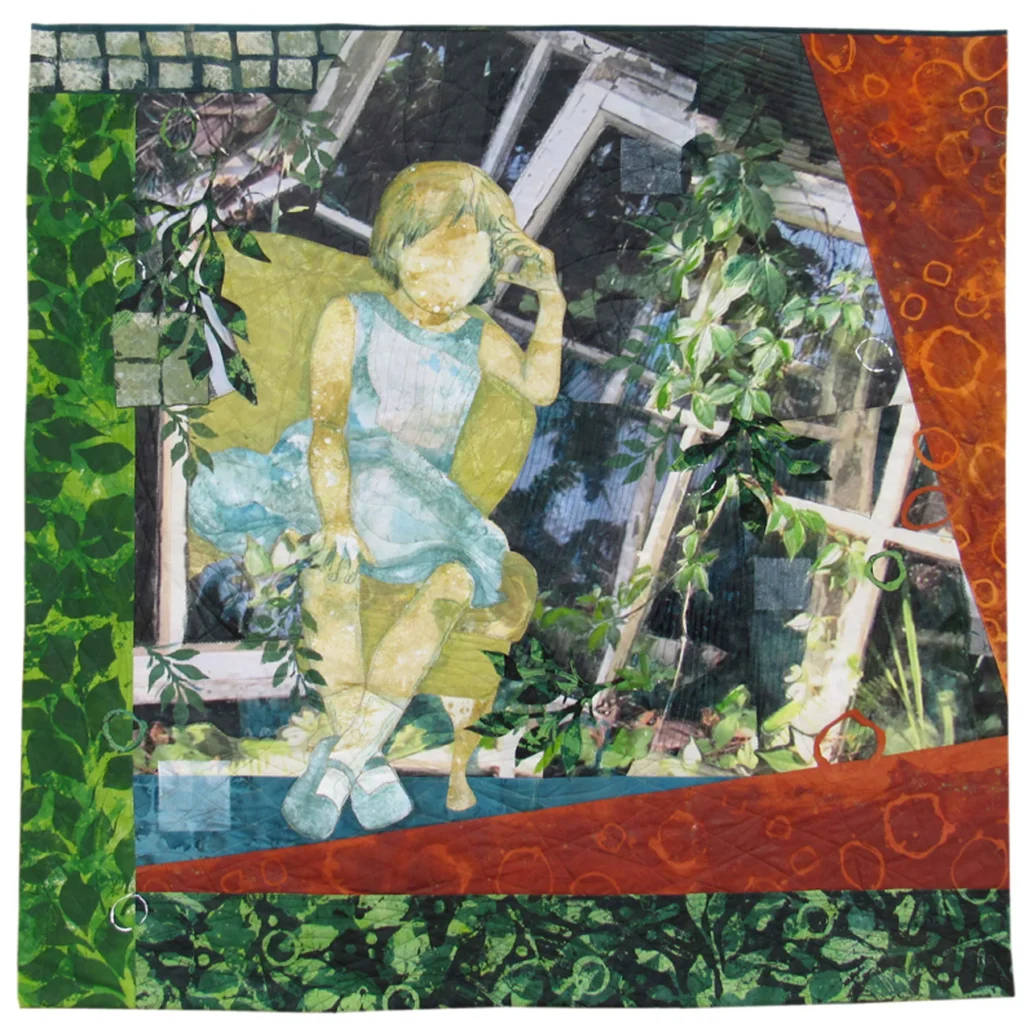
Image: “Overlooked,” an art quilt by Bobbi Baugh
We are delighted to share “Independence Day,” a touching (and bittersweet) poem by Emily Kenner, written on July 5, 2026, during our Art of Writing experience at the Museum of Art–DeLand.
Writers often search for extraordinary subjects, yet some of the most memorable poems begin with an ordinary moment observed with honesty and precision. In “Independence Day,” Emily Kenner invites us into the quiet world of a young child dressed for a holiday celebration but left on the sidelines while the excitement unfolds just out of reach.
Rather than describing fireworks and festivities, Emily turns her attention to waiting—a childhood experience that almost everyone remembers but rarely examines. The result is a gentle, poignant poem that reminds us how different the same day can feel depending on where we stand.
Independence Day
Inspired by Bobbi Baugh’s “Overlooked”
By Emily Kenner
I’m all dressed up
With nowhere to go
My dress is white and blue
With matching shoes
Picked out carefully for the occasion
Yet I sit and wait
I have no responsibilities
But I am not free to choose
The vines and leaves grow
Over the broken window
Pane
And I grow
So slowly
I am too little for this chair
I cannot leave
So I sit here and wait
For Independence Day to finally end
The parade was exuberant
Children chasing candy
So much joy so much
Of everything
And the older kids are lighting fireworks
And playing with sparklers but I’m
Too young for all of that
So here I sit
And wait
For Independence Day
To end
This poem’s greatest strength is restraint. Emily never tells us the child is lonely or disappointed. Instead, she allows those emotions to emerge naturally through concrete details: the carefully chosen dress, the matching shoes, the oversized chair, the parade outside, and the fireworks reserved for older children. Those simple images invite readers to experience the child’s quiet frustration rather than merely observe it.
The repeated phrase, “I sit and wait,” becomes the emotional heartbeat of the poem. Each repetition carries a little more weight than the last, reinforcing the feeling of time stretching endlessly from a child’s perspective. By the closing lines, waiting itself has become the story.
One of the poem’s most effective moments is the image of vines creeping over the broken windowpane while the speaker declares, “And I grow / So slowly.” The comparison is subtle and deeply evocative. Physical growth, emotional growth, and the slow passage of time merge into a single image that lingers long after the poem ends.
Emily also captures a universal truth about childhood: freedom comes in stages. The speaker has “no responsibilities,” yet cannot make a single meaningful choice. That brief observation expresses the paradox of being young with remarkable clarity.
The poem’s language remains simple throughout, which suits its narrator perfectly. Nothing feels overwritten or self-conscious. Every line sounds as though it belongs to the child experiencing the day, allowing the emotional impact to arise from authenticity rather than ornament.
Ultimately, “Independence Day” succeeds because it transforms a seemingly insignificant childhood memory into something universal. Nearly every reader remembers longing to be older, to join the fun just beyond reach, and to discover that waiting can sometimes feel like the longest part of growing up. Emily reminds us that even the quietest moments can hold an entire story.