
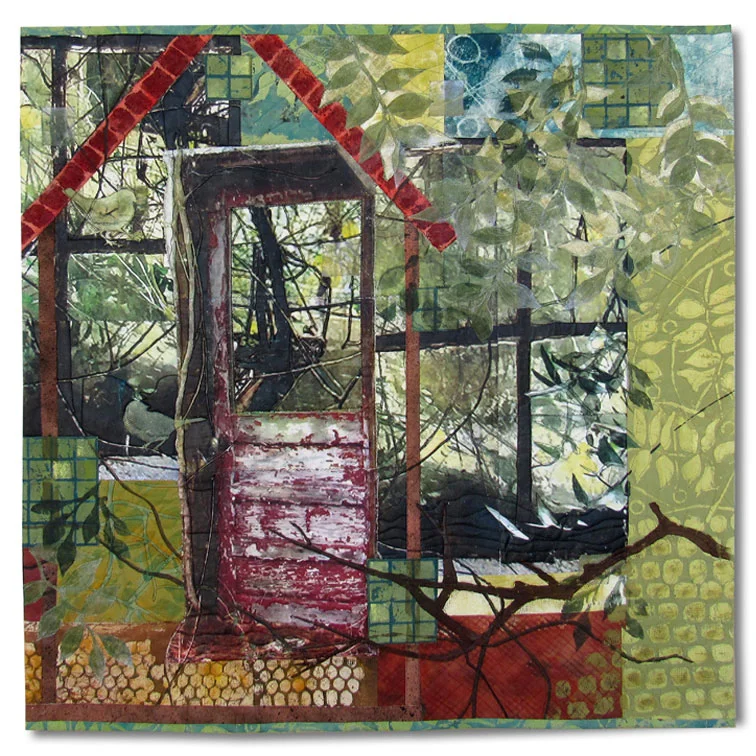
This Is the Way to Get In, an art quilt by Bobbi Baugh
How One Art Quilt Inspired a Powerful New Poem
When a work of art resonates deeply, it often sparks another act of creation. That’s exactly what happened when Stephanie Agosto contemplated a work by Bobbi Baugh during our August Art of Writing experience at the Museum of Art–DeLand.
Here’s what artist Bobbi Baugh says about her piece, This Is the Way to Get In:
I was inspired by photos I took of an abandoned house in South Carolina. The roof was gone and the interior was filled with patterns of light and dark and intertwined limbs and vines. It is a dream and memory quilt, a continuation and development of the “Home” series I created in 2018. (I created another work using these photos in 2018.) I remember being at the house—feeling its emptiness—and wondering at all the stories it held. I wanted to concentrate on the door and the sense of entering into the scene. Beyond that, where the story goes is up to the viewer. The birds are imagined. There were not birds at the actual house I visited. But I like the sense that they may be guides to the journey or messengers of the story.
Here is the poem Stephanie wrote in response.
This is the way to get into the thoughts of my soul
by Stephanie Agosto
An abandoned property
with so much potential
I imagine what
the withered
shell
could be
if reinforced
and taken care of
correctly
A mirrored reflection
from a misplaced
window in my view
triggers a spark
a thought
of how lonely
the structure must feel
being left
unkept
alone
using my imagination
I start to compare
the emptiness
to me and my soul
Seeing and feeling
the similarities
I begin thinking
of all the stories
buried
left untold
The doors representing
the entrance
into the unlimited possibilities
creating Hope
The different colors
light, bold and dark
giving me ideas
right from the start
of how to create
new color themes
to relight the spark within
I hear
the songs
that can be played
throughout
to fill the heart
attracting
New energy
New purpose
ready to be
Refined and
Redefined in time
The roof eliminated to fill the space
with the natural essences using the
sun rays like sunbathing
embraced by the limbs and branches
fortifying the foundation
just like family and friends do
A reminder that with love and light
there is always the capability of
being rebuilt and made new
The scattered windows
are like flashes
of memories
where the stories begin
but do not end
Knowing with
restoration and healing
the house and I will be
creating
new legacies
once the work is put in
Ancestors gazing
just like the birds
watching from the branches
attached
who are not really there
but are there in Spirit.
Commentary
At first glance, Bobbi’s quilt seems to depict an abandoned house slowly surrendering to nature. A weathered red door stands beneath the outline of a roof, while branches, vines, leaves, and layered patterns weave together until it’s difficult to tell where the house ends and the landscape begins. The quilt itself mirrors that idea. Like memory, it is built from fragments: photographs, fabric, color, texture, and overlapping images that invite viewers to fill in the spaces with stories of their own.
Stephanie Agosto transforms the abandoned structure into a deeply personal reflection.
Her poetry belongs to the tradition of free verse, a style that doesn’t rely on regular rhyme or meter. More specifically, it’s an example of ekphrastic poetry—poetry inspired by a work of visual art. The best ekphrastic poems don’t simply describe the artwork. They use it as a doorway into emotion, memory, imagination, and personal truth.
Stephanie begins by observing the house itself. Soon, however, the abandoned building becomes a metaphor for the human spirit.
I begin thinking
of all the stories
buried
left untold
That moment captures something remarkable. The poem shifts from describing a place to discovering a life. The abandoned house becomes the speaker’s own soul, filled not with decay but with possibility.
Throughout the poem, Stephanie continues to build on the visual elements of the quilt. The scattered windows become flashes of memory. The missing roof becomes an opening for light. The surrounding branches become family and friends who strengthen the foundation. Even the birds become ancestors watching over the work of healing.
The poem never abandons the artwork that inspired it. Instead, it returns again and again to details within the quilt, allowing each image to take on new emotional meaning. That’s one of the hallmarks of strong ekphrastic writing: the artwork remains present while the writer discovers something unexpected within it.
The closing lines offer a hopeful vision of restoration:
Knowing with
restoration and healing
the house and I will be
creating
new legacies
once the work is put in
Like the quilt itself, the poem reminds us that broken places are not empty places. They are places where new stories can begin.
When we gather each month at the museum, we don’t come to analyze art as critics. We come as writers. Sometimes a painting becomes a mystery. Sometimes a sculpture becomes a character. Sometimes an abandoned house becomes a reflection of the soul.
We’re grateful to Stephanie Agosto for allowing us to share her work, and to the Museum of Art–DeLand for providing a space where creativity can flourish.
Join us for the next Art of Writing experience and discover how great art leads to great stories.
The way that Stephanie writes isn’t just deeply personal, it touches the reader…making them want to close their eyes and feel the same emotions and thoughts as she is.